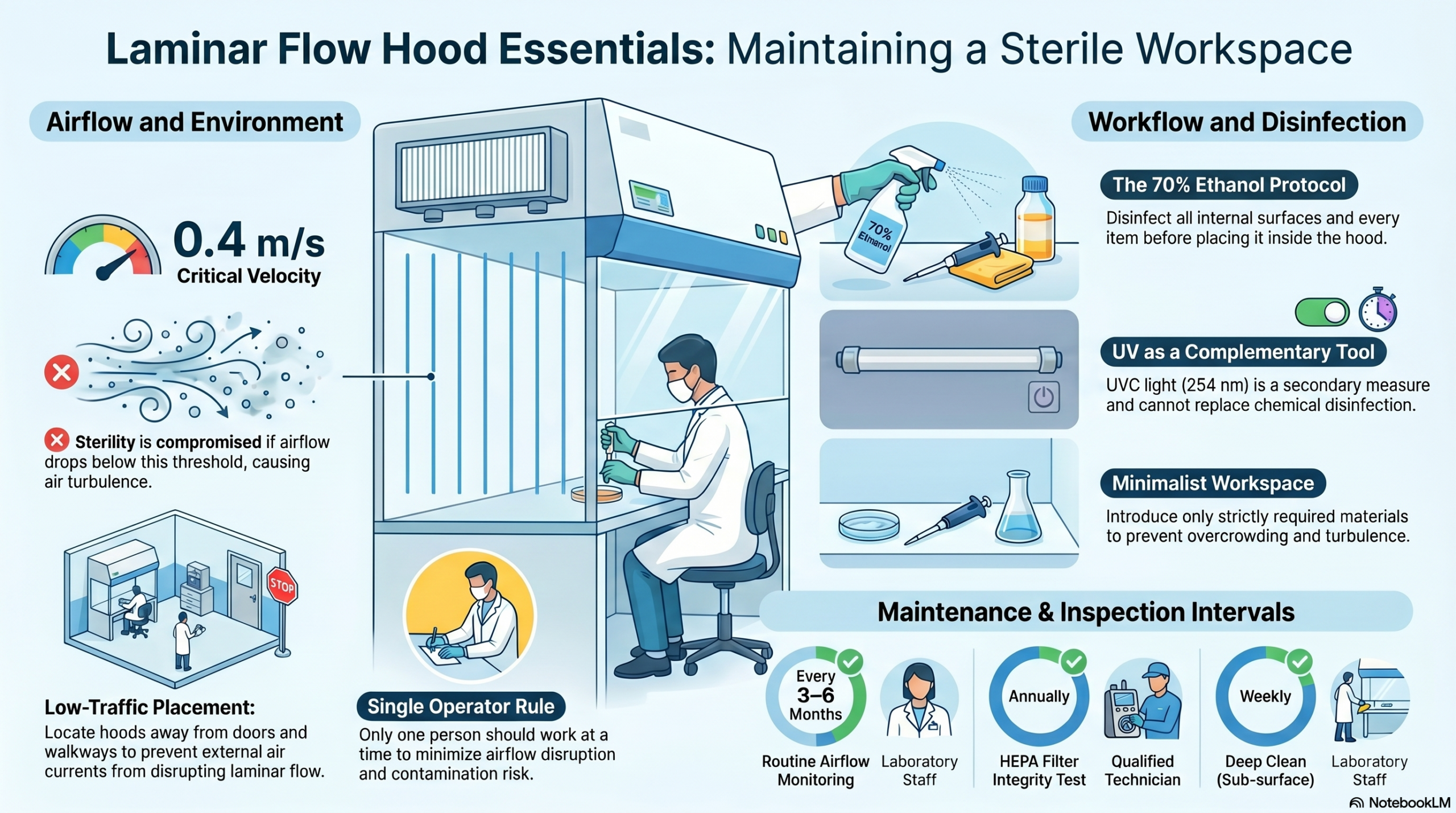
Once the appropriate laminar flow hood has been selected and installed, correct usage is essential to ensure both experimental reliability and personal safety.
The following practical guidelines can significantly improve the quality and sterility of cell culture work.
AIRFLOW
Vertical laminar flow hoods maintain sterility by directing HEPA-filtered air from the top of the cabinet toward the work surface.
Their efficiency depends on maintaining appropriate airflow velocity and pressure across the filter. If airflow is reduced below approximately 0.4 m/s, laminar conditions may be compromised, increasing the risk of contamination.
Airflow velocity can be measured using a simple anemometer. Periodic checks are recommended:
- Every 3–6 months for routine airflow monitoring
- Annually for professional inspection of HEPA filter integrity
Filter testing and replacement must be carried out by qualified technicians.
To preserve airflow stability, the hood should be located in a low-traffic area. Frequent movement of personnel or air currents caused by speaking, walking, or nearby equipment can disrupt laminar flow and increase contamination risk.
WORK SURFACE
Only one operator should work inside the hood at any given time.
Although a single hood may be shared by multiple users throughout the day, simultaneous use significantly disrupts airflow and increases contamination risk.
Before starting work:
- Clean all internal surfaces with 70% ethanol
- Introduce only the materials strictly required for the procedure
- Disinfect all items before placing them inside the hood
During work:
- Avoid overcrowding the workspace
- Maintain order to preserve airflow
- Minimize unnecessary movements
Overcrowding generates air turbulence and increases the risk of contact between sterile instruments and non-sterile surfaces.
Between procedures:
- Remove unnecessary materials
- Clean the working area with 70% ethanol
In case of spills:
- Clean immediately
- Disinfect the affected area thoroughly
Routine maintenance is also essential. At least once a week, the area below the work surface should be cleaned using ethanol, followed by a suitable disinfectant such as virkon.
UV LIGHT
UV light is sometimes used to reduce microbial load on exposed surfaces between working sessions.
Germicidal lamps emit UVC radiation (typically around 254 nm), which damages DNA and RNA, leading to loss of cellular function and death.
Therefore, UV light has important limitations:
- It is effective only on directly exposed surfaces
- It cannot penetrate materials or reach shaded areas
- It does not replace proper chemical disinfection
Therefore, UV lamps should be considered a complementary tool rather than a primary method of decontamination.
Practical recommendations for UV use
- Always disinfect surfaces before switching on UV light
- Perform a second cleaning after UV exposure
- Never rely solely on UV for sterilization
It is also important to note that prolonged UV exposure can damage certain materials, including plastic surfaces such as Perspex or Plexiglas, leading to microcracks over time.
Concluding remarks
Proper use of the laminar flow hood is essential to maintain sterile conditions and ensure reliable experimental results.
Even the most advanced cabinet cannot compensate for incorrect technique. Careful handling, proper maintenance, and awareness of airflow dynamics are critical to minimizing contamination risks in cell culture work.