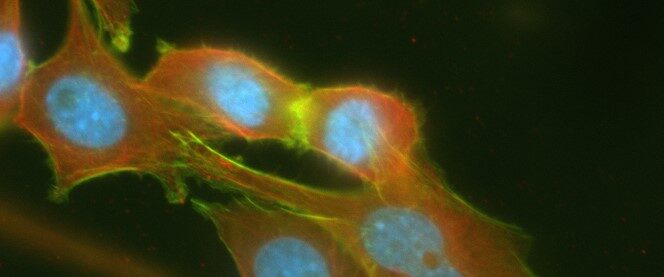
This page provides a structured overview of the main topics in cell culture.
First, fundamental concepts are introduced. Then, laboratory setup and aseptic techniques are described.
Finally, practical protocols and methods for cell culture analysis are presented.
1. Introduction
- advantages of cell culture 1: Environmental control
- advantages of cell culture 2: Cellular homogeneity
- advatanges of cell culture 3: other factors
- Limitation of cell cultures 1: Phenotypic and genotypic variability
- Limitations of cell culture 2: morphological and functional differences with cells in vivo
2. Layout of the cell culture laboratory and necessary equipment
- Laminar flow hood
- Laminar flow hood: selection and installation.
- Laminar flow hood: working tips
- Water bath: mainteinance and usage protocol to avoid contamination
- CO2 incubators
3. Aseptic technique
- Decontamination
- aseptic technique SOP
- A guide to cell-lab personal hygiene
- Other tips for sterile handling
4. Culture media
- Cell culture media history
- CO2 independent media
- How to Adapt Cells to CO2-Independent Media: Step-by-Step Protocol
4.1 Phisicochemical properties
4.2 The components of cell culture media
- The components of the cell culture medium: HEPES
- The components of the cell culture medium: glutamine
- Phenol red
5. Culture Vessels
- Cell Culture Vessels: Choice of Substrate Materials and Their Effects on Cells
- How to Prepare Glass Coverslips for Cell Culture: Step-by-Step Protocol
6. Media and reagents
- Media, reagents, and solution preparation
- Preparation of cell culture media
- PBS recipe and preparation
- Protocol: 4% Paraformaldehyde solution in PBS
- Scott’s tap water substitute
7. Subculture
8. Quantitation
-
- Cell Seeding Density Calculation: Formula, Examples, and Practical Guide
-
Cell Seeding Volume Calculation: From Cells/mL to Cells/cm² Step by Step
- Cell counting
- Methods to estimate Cell Confluency
9. Contamination
- Cell culture contamination: main causes
- Contaminated! When you see it by eye
- Contamination: when it is hard to detect – Mycoplasma
- Summary of contamination preventive methods
- Summary of Contamination Containment Methods
- Decontamination
- Eradication of fungus and mold contamination
- Eradication of bacteria contamination
- Eradication of mycoplasma contamination: antibiotics
Protocol: eradication of mycoplasma from cell culture
Science for schools
Level: Middle school (ages 11–14)
Discover how yeast produces gas and how sugar affects cell metabolism with a simple and safe experiment.
Level: Primary to Middle School (ages 8–14)
Discover what a cell is and how it works through a simple explanation and a hands-on experiment using an egg as a model.