Another way to indirectly estimate the number of cells in a sample is to evaluate the protein content using the Bradford method.
Quick description of the method
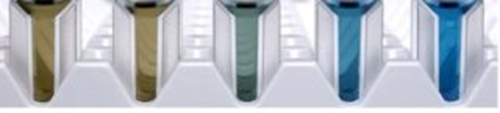
The method, first described by Dr. Marion Bradford in 1976, is based on a colorimetric reaction of proteins with a dye, Coomassie Brilliant Blue G-250. The proteins bind to the dye in an acidic environment, inducing a spectral shift from the brown colour (maximum absorbance at 465 nm) to the blue (maximum absorbance at 610 nm). Hydrophobic and ionic interactions with the proteins in the sample stabilize the anionic form of the dye, causing a visible color change.
The developed blue color is therefore proportional to the protein content and can be measured spectrophotometrically at 595 nm, the wavelength where the difference in absorbance between the two coloured forms of the dye is greater.
By creating a calibration curve using known concentrations of proteins as a standard (see below), it is then possible to uncover the unknown protein concentration of a solution, based on the absorbance of the solution after adding the dye.
Some tips before starting
- The assay is performed at room temperature.
- The Bradford method is compatible with most salts, solvents, buffers, thiols, reducing substances, and metal chelating agents in protein samples, but not with detergents [Stoscheck, C. M. (1990 -1) ]
The presence of detergens (i.e 0.1% SDS – but not 0.02% SDS – and 0.5% Tryton – but not 0.1% Tryton) at concentrations usually used to solubilize the cell mambranes causes precipitation of the dye, therefore interferring with the measurements.
If there are detergents in your sample, you can 1. eliminate the detergent by i.e. gel filtration or dialysis, 2. include the detergents in the reagent blank and calibration standards exactly at the same concentration as in the sample 3. choose another method for protein quantification
- The presence of a base in the assay results in an increase in absorbance by shifting the balance of the free dye towards the anionic form. This can cause problems if the test is performed on samples dissolved in a buffer with a high base concentration [Stoscheck, C. M. (1990 -1)]
- The presence of glycerol, ascorbic acid, guanidine idrochloride, 10 mM EDTA or salt highly concentrated (4M NaCl) may interfer with the assay [Stoscheck, C. M. (1990 -1)]
If one or more of the listed substances are present in the unknown protein solution, it is important to evaluate their effects on absorbance by creating standard curves both in the presence and absence of these compounds.
If strong interference is observed, protein precipitation with deoxycholate/trechloroacetic acid can be performed to remove the interfering compound and recover cytosolic and mebrane proteins
- Free amino acids, peptides and low molecular weight proteins do not produce color by reacting with Coomassie dye reagents. Therefore these molecules do not interfere with spectrophotometric reading and protein assay. As a rule of thumb, the mass of a peptide or protein should be at least 3,000 Da for quantification with this reagent.
Bradford method: Protocol
Equipment
To perform the test you’ll need pipette and epps, a visible light spectrophotometer and polystyrene (cheap) cuvettes.
The coomassie dye leaves a bluish patina on the cuvette that is almost impossible to remove. For this, it is better to use disposable polysitrene cuvettes
Reagents
BRADFORD REAGENT:
Prepare the reagent working under a fume hood.
- Dissolve 100 mg Coomassie Brilliant Blue G-250 in 50 ml of 95% ethanol (Ethanol may be replaced with methanol – same amount – which is cheaper but definitely more toxic than ethanol!!)
- add 100 ml 85% (w/v) phosphoric acid
- When the Coomasie has completely dissolved, add the solution to 500 ml of water (Caution: Always add acid slowly into water and do not add water into acid).
- Bring the volume to 1 liter, adding additional water
- filter through Whatman Grade 1 Qualitative Filter Paper (11 µm particle retention)
- keep in an amber bottle at room temperature. It is stable for several weeks. If you observe the formation of precipitates over time, it will be necessary to refilter the solution
The Bradford reagent should be light brown in color. Filtration may have to be repeated to rid the reagent of blue components.
The Bradford reagent is stable for several weeks.
The Bio-Rad concentrate is expensive, but the manufacturer screened the lots of dye for maximum effectiveness and reproducibility. The “Homemade” reagent works quite well but is usually not as sensitive as the Bio-Rad product.
PROTEIN STANDARD
The most commonly used standards for the Bradford assay are bovine serum albumin (BSA) and bovine γ-globulin (BGG) solutions. Ovoalbumin may be used as well.
BSA 1mg/ml
To prepare a 1 mg/ml BSA solution, weigh 10 mg BSA and dissolve it in 10 ml of double distilled H2O.
To avoid clumping, dissolve by layering the powder on the surface of the liquid while stirring. As BSA solution tends to be foamy if strongly shaken, gently rock the capped tube until the BSA has dissolved completely or stir gently with a magnetic anchor on a stirrer. Store in disponsable aliquots at −20°C.
The absorbance at 280 nm of this solution in a 1-cm-path-length quarz cuvette should be 0.66 .
Calibration curve
- Turn on the spectrophotometer
- Place 1, 5, 10, 15, 20 and 30 µl (in duplicate) of a 1 mg / ml solution of BSA (or other protein used as standard – see note 1 below) in twelve microcentrifuge tubes, and dilute to 100 µl with distilled water (or in the protein solubilization buffer). This way you put 1, 5, 10, 15, 20 and 30 µg of BSA protein into the sample.
- In two other microtubes, used as blank, place 100 µl each of distilled water (or the protein solubilization buffer) .
- Add 1 mL of Bradford Reagent Solution and mix thoroughly by inverting the tubes. Mix gently to avoid foaming which will reduce reproducibility
- Leave the tubes to stand for at least 2 minutes at room temperature and for up to one hour maximum.
- Measure absorbance at 595 nm using a microcuvette (1 ml)
- Create a standard curve by plotting absorbance at 595 nm against protein content (in µg).
As a reference, consider that the absorbance at 595 nm of a sample containing 10 µg γ-globulin (or ovoalbumin) is approximately 0.45, that of a sample containing 10 ug of BSA is approximately 0.8. Remember that the precise absorbance varies according to the aging of the Bradford reagent. Consequently, it is essential to construct a calibration curve for each set of assays.
Note 1
Ideally the protein used to create the calibration curve should be the same protein analyzed, because the ability to interact with the dye, and therefore the development of the blue color, varies with the variation of the protein(s).
Since in the case of cellular protein the use of the same proteins to construct the calibration curve is impossible, the protein standards listed above are used.
The protein most often used to construct the standard calibration curve is bovine serum albumin, as it is inexpensive and easily available. Many researchers conducted their studies using this protein as standard. However, BSA, compared to other “average” proteins, shows a much higher affinity for the dye, with greater development of blue color with the same protein concentration. By using BSA as a standard, you run the risk of underestimating the protein concentration of the sample.
For this reason, gamma-globulin would be the most suitable standard protein.
Given this variation, it is always good to specify the standard protein the calibration line was created by the Bradford method
Assay
- Pipette duplicate samples containing 1-20 µg of the protein(s) in a total volume of 100 µl into 1.5 mL polyethylene microcentrifuge tubes. If you don’t know the approximate concentration of the sample, analyze a dilution range (1, 1/10, 1/100, 1/1000) as in the table below in order to have a sample with an absorbance that falls within the range of the curve calibration.
Remember to multiply the protein content obtained by the dilution factor (i.e. 1, 10, 100, 1000) at the end of the analysis to determine the real protein content.
- Add 1 ml dye reagent
- Leave the tubes to stand for at least 2 minutes at room temperature and for up to one hour
- Measure the absorbance at 595 nm and calculate the protein content by referring to the calibration line constructed earlier.
Remember that the test must remain linear and follow the law of Lambert Beer ! If the absorbance is greater than 1.3 units of absorbance (AU), dilute further the sample(s) (taking note of the dilution to go back to the initial protein content) and repeat the measurement!
Analysis
Prepare a standard curve of absorbance versus micrograms protein and determine the amount of protein(s) in your sample from the curve. Determine concentrations of original samples from the amount protein, volume/sample, and dilution factor, if any.
Remember to multiply the protein content obtained by the dilution factor (i.e. 1, 10, 100, 1000) at the end of the analysis to determine the real protein content.
Comments
The dye used in the Bradford method reacts primarily with arginine residues and less so with histidine, lysine, tyrosine, tryptophan, and phenylalanine residues. Obviously, the assay is less accurate for basic or acidic proteins.
The Bradford method is subject to variations in sensitivity between the individual proteins. This variability can be reduced by making changes to the method [Reade et al., 1981; Stoscheck, 1990-1]. These changes require increasing the dye content or pH of the solution. In the method proposed by Stoscheck (1990-1) for example, increasing the pH by adding NaOH to the reagent allows the solubilization of membrane proteins, improves the sensitivity of the assay and greatly reduces the variation among different proteins. However, the modified assay is much more sensitive to interference from detergents in the sample.
For routine measurement of the protein content of many samples the Bradford method may be used with a microplate reader [Redinbaugh et al., 1985]. In this case the author reduced to 0.2 ml the total volume of the assay, with the use of equal volumes of sample and diluted stain reagent. The advantage is to save both sample and dye, making the test faster with the use of a microplate reader
See also
Small essential bibliography
- Bradford, MM. A rapid and sensitive for the quantitation of microgram quantitites of protein utilizing the principle of protein-dye binding. Analytical Biochemistry 72: 248-254. 1976.
- Stoscheck, CM. Quantitation of Protein. Methods in Enzymology 182: 50-69 (1990)
- Stoscheck, C. M. (1990 -1) Increased uniformity in the response of the Coomassie blue protein assay to different proteins. Anal. Biochem. 184, 111–116.
- Friendenauer, S. and Berlet, H. H. (1989) Sensitivity and variability of the Bradford protein assay in the presence of detergents. Anal. Biochem. 178, 263–268.
- Reade, S. M. and Northcote, D. H. (1981) Minimization of variation in the response to different proteins of the Coomassie blue G dye-binding assay for protein. Anal. Biochem. 116, 53–64.
- Redinbaugh, M. G. and Campbell, W. H. (1985) Adaptation of the dye-binding protein assay to microtiter plates. Anal. Biochem. 147, 144–147.