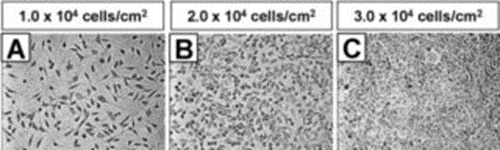
What is the cell seeding density?
Cell seeding density (cells/cm²) is defined as the number of cells per unit surface area.
Using cell density allowsto make the growth and cell proliferation data homogeneous and independent from the growth vessel used, while the total number of cells depends on the on the available growth area.
👉 In simple terms:
the larger the surface, the greater the total number of cells that can grow.

Why is seeding density important?
Cell seeding density strongly influences:
- cell growth rate
- morphology
- phenotype
- experimental outcomes
👉 For this reason, it is essential to maintain a consistent cell density across experiments.
Let me explain better with an example:
if you want to keep the same cell density, the total number of cells to be plated in a 96 well, which generally has a surface of 0.3 cm2, will be much less than the number of cells to be plated in a 25 flask, So, if for a certain cell line you establish that you have to seed 10,000 cells in a 96 well, then in a 25-cm2 flask you will have to seed 10,000 / 0.3 * 25 cells in total. In this way the cell density will be kept constant.
Similarly:
If a 96-well reaches confluence at approximately 40,000 cells, then a T25 flask would contain approximately:
(40,000 / 0.3) × 25 ≈ 3,300,000 cells
👉 This can be useful for estimating yield for downstream experiments.
The formula
The formula for calculating the cell number in 1 cm2, that is the cellseeding density (SD), is:
SD = N/A
where
- SD = seeding density (cells/cm²)
- N = total number of cells (NOT cells/mL)
- A = surface area (cm²)
Conversion between vessels
If it is necessary to calculate the number of cells to be plated in a well of different format, then the formula to be used to maintain the same seeding density (SD) will be:
N2=(N1/A1)*A2 or N2=SD1*A2
where:
- N₂ = number of cells to seed in the new vessel
- N₁ = number of cells in the original vessel
- A₁ = surface area of the original vessel
- A₂ = surface area of the new vessel
Related calculations
👉 To calculate the required cell concentration (cells/mL) to plate the cells at the desidered cell density after trypsinization, see the dedicated guide.
👉 For information on cell detachment methods, see the related article.
Scientific rilevance
Cell seeding density regulates many aspects of cell properties and behaviors including metabolism, growth, cytoskeletal structure. See for example
- Fluctuations in cell density alter protein markers of multiple cellular compartments, confounding experimental outcomes
- A Cell Density-Dependent Reporter in the Drosophila S2 Cells
- Mechanisms and in vivo functions of contact inhibition of locomotion
- Cell density and actomyosin contractility control the organization of migrating collectives within an epithelium
- Yes-associated protein (YAP) and transcriptional coactivator with PDZ-binding motif (TAZ) mediate cell density–dependent proinflammatory responses
- Expression of surfactant protein B is dependent on cell density in H441 lung epithelial cells
- Notch signaling regulates cell density-dependent apoptosis of NIH 3T3 through an IL-6/STAT3 dependent mechanism
- High Cell Density Induces Vascular Endothelial Growth Factor Expression Via Protein Tyrosine Phosphorylation
Useful information:
Growth areas of various culture vessels:
| Cell culture vessel | Growth area in cm2 |
| Multiwell plates | |
| 96 | 0,30 |
| 48 | 0,70 |
| 24 | 2,00 |
| 12 | 4,00 |
| 6 | 10,00 |
| Dishes (diameter) | |
| 35 mm | 10,00 |
| 60 mm | 20,00 |
| 100 mm | 60,00 |
| 145-150 mm | 140,00 |
| Flasks | |
| T25 | 25,00 |
| T75 | 75,00 |
| T150 | 150,00 |
| T162 | 162,00 |
⚠️ Note:
Growth areas may vary slightly depending on the manufacturer.
👉 Always verify the specifications provided by the supplier.
Conclusion
Cell seeding density is a fundamental parameter in cell culture.
Maintaining a constant density across different experiments ensures:
- reproducibility
- consistency
- reliable comparison of results