The preparation of cell culture media must be performed under aseptic conditions ad varies depending on the initial medium stock available.
Cell culture media are available on the market in different formats:
1) powdered. They are the cheapest but must be prepared in the laboratory and sterilized. They are therefore the most time-consuming and can lead to some sterility issues if not properly prepared
2) concentrated liquid (10×). These media must be diluted to the working concentration in the laboratory. They are generally less expensive than ready-to-use 1× media, but still require sterilization
3) ready-to-use liquid (1X). They are the most expensive, but most time saving as they’re nearly ready to use.
Quick summary
Preparation of medium from 1X liquid stock
Preparation of medium from 10X liquid stock
how much of bicarbonate add to the medium
Preparation of medium from powder.
Storage of cell culture media
Preparation of medium from 1X liquid stock
Check the formulation of the cell culture medium and determine if and what needs to be added (the most frequent components to add are usually serum and glutamine)
- Prepare the medium, serum, glutamine and each additive that your medium needs under the sterile hood (remember to wipe the outside of each container with 70% alcohol)
Note
2. Prepare the serological pipettes you need under the hood
Note
If you need to add a small volume of any particular component and therefore you need to use a micropipette, remember to use filter tips to avoid contamination risks).
3. When all components are at room temperature, open the medium. Leave the cap loose, but on the bottle in order to avoid the possibility to pass over the bottle opening while you’re working.
4. Suck up the first component you should add, lets say glutamine, with a serological pipette, move the pipette towards the bottle of medium, lift the cap with one hand and with the other hand (in which you hold the pipettor) pipette down the glutamine into the medium
Note
For glutamine usually 5 ml in 500ml of complete medium is added (glutamina stocks on the market are usually 200 mM, and glutamine in the media should be 2 mM).
Anyway, to be really precise and understand the real calculation you have to do, let’s look at the calculation in more detail.
If the glutamine concentration is 200mM and you need 2mM (that is: the stock solution is 100X and you need to dilute it 1:100) , you will need to add 5.05ml of glutamine in 500 ml of medium.
in fact
The general formula for calculating a dilution is (Ci) (Vi) = (Cf) (Vf)
where Ci is the concentration of the starting solution. Vi is the volume of the starting solution. Cf is the concentration of the final solution. Vf is the volume of the final solution
but here
Ci = 200 mm, Vi is the unknown volume to calculate, Cf is 2 mM and Vf is (500 ml + Vi)
That is: it is necessary to consider that the final volume of the solution will not be 500 ml, but 500 ml plus the ml of glutamine solution added.
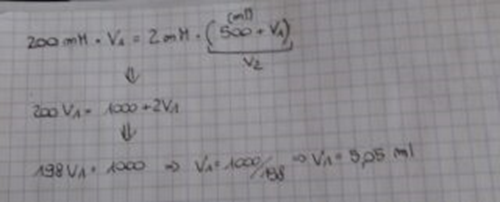
this formula should be used for each component to be added.
However, the smaller the volume to be added, the smaller the change in the final volume making the change in the final volume negligible,
For glutamine usually 5 ml is added, as the error is negligible
5. (if necessary) add serum. This is the last component to add because when agitated it causes the formation of foam which can cause a bad measurement of the volume, can lead to the denaturation of proteins and can reach the edge of the container favoring contamination.
if you need to add 10% serum to 500 ml of medium, the formula to use is the same as shown above.
In 500ml of medium, you will therefore need to add 55 ml of serum, not 50!
and if you added 5ml of glutamine now the final volume will be 505ml, so the volume of serum to add will be 56ml (56.1ml to be super precise).

6a. if you are using a low bicarbonate culture medium (which can be used in the presence of environmental CO2), you just have to close the bottle and place it in the refrigerator.
If all the components you’ve used are sterile, you don’t need to further sterlize the medium
6b.if you are using a culture medium with a high concentration of bicarbonate (which requires the presence of 5% CO2 to be balanced), you must gas the the upper part of the bottle empty of medium with 5% CO2 and close the bottle.
This operation must be done every time you open the medium, otherwise the medium gradually becomes more alkaline over time (if there is phenol red you can see that it turns pink).

To overcome this problem (and to reduce the possibility of contamination of a whole lot of medium), it is possible to divide it into small aliquots in 50 ml Falcon tubes to be filled almost to the brim in order to limit the air content in the Falcon tube.
7.put the complete medium at 4 ° C.
Since many components in the media are subject to photo-conversion or photo-degradation following exposure to ambient light even for a few hours, remember to store the medium in the dark as much as possible (Neutsch et al., 2018).
Preparation of medium from 10X liquid stock
In this case it is first necessary to dilute the concentrated medium 10 x to 1 x (dilution 1:10) with sterile water.
To do so:
- Prepare a 1L sterile beaker under the hood and fill it with 800 ml of sterile water, add 100 ml of 10X concentrated medium.
Concentrated medium usually does not contain sodium bicarbonate which must be added to the concentration required.
————————————————————————————————————————————————–
HOW MUCH SODIUM BICARBONATE SHOULD YOU ADD?
This table shows some widely used culture media, the “working” concentration of bicarbonate in the presence of the reported CO2 and the volume of a 0.75% solution (ie 0.89M or 75 g / L) of bicarbonate to be added.
| Eagle’s MEM Hanks’s salts | Eagle’s MEM Earle’s salts | DMEM (Dulbecco’s modified Eagle’s medium ) | |
| NaHCO3 (g/L) | 0,35 | 2,2 | 3,7 |
| NaHCO3 (mM) | 4,2 | 26,19 | 44 |
| % CO2 | atmospheric | 5 | 10 |
| ml of 7,5% (0.89M) sodim bicarbonate solution * | 4,7 | 14,9 | 49,3 |
*since the solubility of bicarbonate in water decreases as the temperature decreases and at 0 ° C it is 69 g / L, it is necessary to keep the bicarbonate solution in the refrigerator.
If precipitates form, bring the solution to room temperature (the solubility in water at 20 ° C is 96 g / L).
It is therefore important to leave the bicarbonate solution at room temperature under the sterile hood before adding it to the medium.
———————————————————————————————————————————————————
If you need to add other components dissolved in aqueous solution (such as HEPES 1M in water), you must add them at this time, before making up to volume, so as not to dilute the salts of the ready-made culture medium.
Since the pH of all 10X media is acidic, to improve the solubility of the components, it may be necessary to adjust the pH.
It is necessary to bring the pH of the medium to a value that is 0.3 -0.1 units lower than the working one (eg 7.1 or 7.3 rather then 7.4) because the pH will subsequently increase slightly due to filtration.
If you are using a CO2 independent medium, you should simply proceed to adjust the pH of the medium, BUT if you are preparing a culture medium that requires incubation in the presence of a higher concentration of CO2, pour a small aliquot of medium in a sterile beaker, leave it overnight in the incubator and proceed to adjust the pH of this aliquot, noting the volume of base to add.
Making the appropriate proportions, add the right quantity of base also to the remaining medium (stored overnight in the refrigerator).
By using a sterile glass flask regulate the volume to 1 liter.
Sterilize the medium by filtration using a positive-pressure system.
Check again the pH.
Now you can add serum, glutamine etc., as mentioned for the preparation of the complete medium starting from the 1x stock solution (see above)
Preparation of medium from powder.
In this case you have to pour 800 ml of water (if the preparation is for 1 L) in a sterile beaker. Use room temperature water.
Add a magnetic stir bar and, stirring, slowly add the powder. Wait until it is completely dissolved.
Rinse the inside of the medium package with a little bit of water to remove all traces of powder. Add this to the beaker
Then proceed to add sodium bicarbonate and other components as specified for medium prepared from 10x stock
Bring to pH, as specified above, bring to volume and sterilize by filtration (see prep of medium from 10 x concentrated for more detail)
Storage of cell culture media
Due to their complex composition and their content of both thermically and photochemically unstable elements (Nielsen et al., 1991; Neutsch et al., 2018), cell culture media are intrinsically subject to significant compositional variations particularly when they are in the liquid state (Calvet et al., 2014).
The degradation of cell culture media can have negative effects on cell viability and thus on experimental performance (Zang et al., 2011; McElearney et al., 2016)
It is therefore necessary that they are stored IN THE DARK and at 4 ° C.
Furthermore it is better to heat (at 37°C, or anyway at the working temp) only the amount of culture medium you need.
It is advisable, both for this reason, and to limit the loss of protons due to the loss of CO2 and the consequent excessive basification of the medium, to aliquot it, immediately after its preparation.
Just to give a complete information, BenchStable Media are now available on the market (for example by Gibco). Although stable at room temperature, they should not be exposed to direct light.
Alpha-ketoglutaric acid has been shown to be an additive for cell culture media to limit the degradation of components even at room temperature (Schnellbaecher et al., 2021).
However, it should be noted that this antioxidant can lead to alterations of some cellular functions (Baracco et al., 2019; Shaojuan et al., 2018)