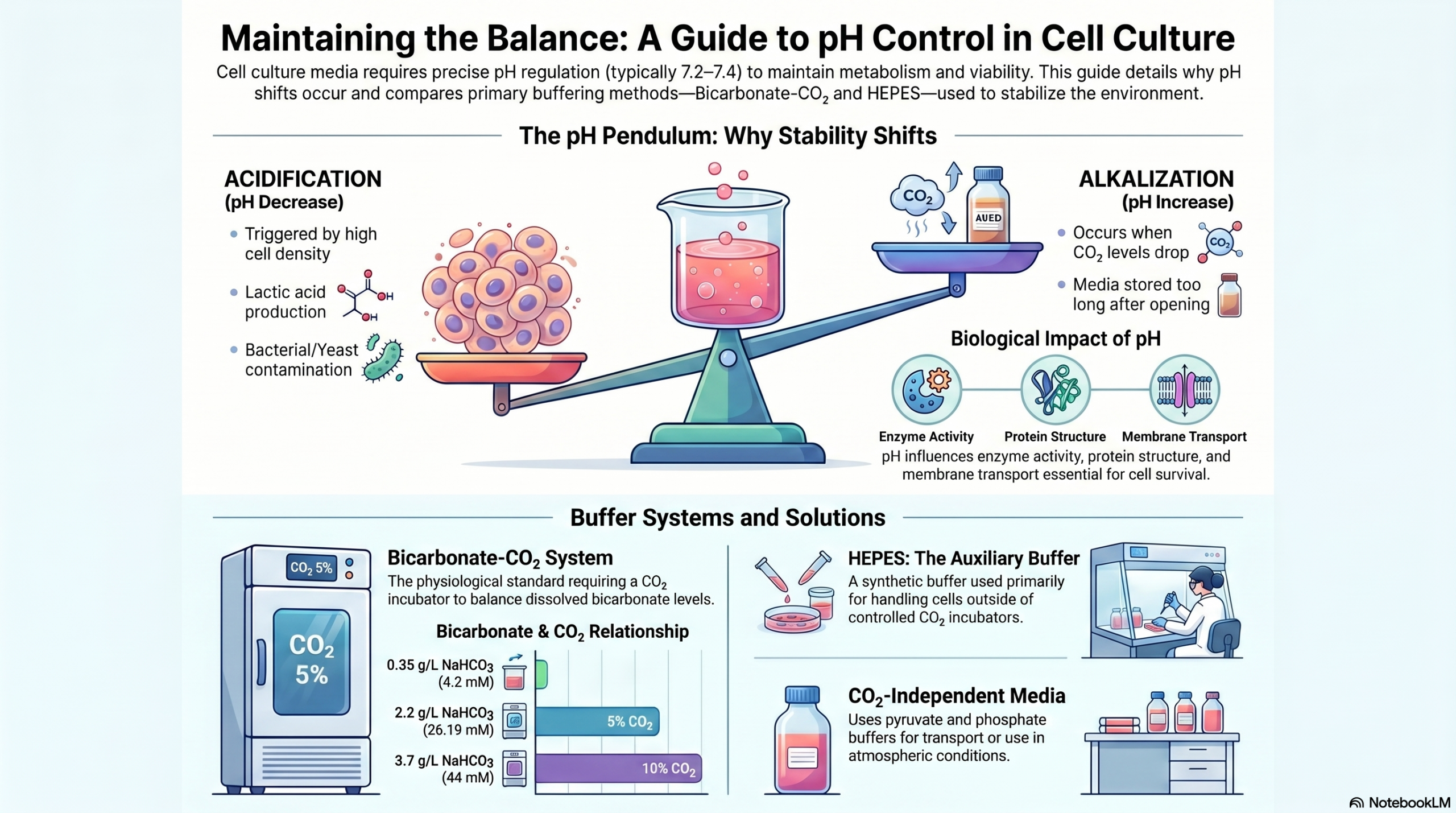
Maintaining a stable pH level is essential for cell culture success because fluctuations can damage metabolism and viability. This source explains that while most mammalian cells thrive near a neutral pH, specific conditions like high cell density or contamination can cause harmful acidification. To counter these changes, researchers utilize buffer systems such as the Bicarbonate-CO2 method, which mimics natural physiological regulation but requires a specialized incubator. Alternatively, HEPES serves as a synthetic addition that provides stability during benchtop manipulations where CO2 control is unavailable. The text also highlights CO2-independent media as a practical solution for transporting tissues or conducting experiments in standard atmospheric conditions. Overall, the material serves as a guide for selecting the appropriate buffering strategy based on specific experimental needs.
“
Why pH is important
The pH of cell culture media must be balanced and stable over time. Biological processes are highly sensitive to changes in pH. Indeed pH influences enzyme activity, membrane transport, protein structure, lipid interactions
Human blood is maintained at pH 7.35–7.45. For this reason, most mammalian cell cultures grow best at pH 7.2–7.4.
However, optimal pH depends on the cell type. Insect cell lines such as Sf9 and Sf21 grow optimally at pH 6.2.
Why does medium pH change during culture?
Sometimes, by maintaining the cells in culture for a certain period of time without changing the medium, you will have noticed that the medium is acidified (if it contains phenol red, this will become more orange-yellowish). Why?
The culture medium generally faces more or less marked acidification depending on the cell type, number and the buffer capacity of the culture medium.
Waste products (acidic metabolites) released by cells – grown too dense or grown too long in that medium – or excessive growth of contaminants -bacteria and yeasts- will also cause a decrease in pH. Cultivating in the presence of low oxygen levels can also promote the production of lactic acid by the cells, which will reduce the pH of the culture.
An excessive increase in pH can be observed when the medium is left too long in the fridge after opening or when the CO2 level in the incubator is reduced due to a technical problem.
Phenol red, also known as phenolsulfonphthalein, is commonly used as an easily visible pH indicator of cell culture media.
See this article to have information about phenol red (function, advantages and disadvantages).
Main causes of pH decrease
- high cell density
- long culture time without medium change
- contamination (bacteria or yeast)
- low oxygen levels (increased lactic acid production)
Causes of pH increase
- low CO₂ levels in the incubator
- prolonged storage of opened medium
Buffer system in cell cultures
Since biological processes are sensitive to pH, cell culture media need to be buffered.
A buffer is an aqueous solution consisting of a mixture of a weak acid and its conjugate base, or vice versa. A buffered solution resists changes in pH when acids or bases are added, thus ensuring a good stability of the pH of the medium in which the cells grow.
The pH buffer capacity is maximum, in a closed system, when equimolar amounts of the protonated and deprotonated form of the buffer are present, which is achieved when the pH of the solution coincides with the pKa of the buffer.
A list and a discussion of the buffers that can be used in biomedical research was originally given by Good et al. (1966) and continued by Ferguson (1980).
Nowadays, animal cell cultures are maintained at physiological pH primarily by two different buffer systems: Bicarbonate-CO2 and HEPES (N-2-hydroxyethylpiperazine-N’-2-ethanesulphonic acid).
Bicarbonate-CO2 system
In an open system, such as the organism, the bicarbonate–CO₂ system is the main buffering system.
Despite its relatively low pKa (~6.15), the concentrations of the acid (CO₂) and base (bicarbonate, HCO₃⁻) can be actively regulated by the lungs and kidneys, allowing the pH to be maintained within a narrow physiological range.
This is also the most commonly used buffering system in cell culture.
In cell culture, the bicarbonate–CO₂ system works by matching the concentration of dissolved bicarbonate in the medium with a controlled level of CO₂ gas, which is maintained by a CO₂ incubator.
Even though this system has a relatively limited intrinsic buffering capacity and requires an incubator to control CO₂ tension, it is still widely used because of:
- low toxicity
- low cost
- physiological relevance
- nutritional benefits for cells
The presence of bicarbonate ions has important physiological implications. Bicarbonate activates membrane transport processes involved in cell pH homeostasis, influencing intracellular pH regulation as well as the sensitivity of cells to changes in extracellular pH.
This represent a physiological signaling mechanism, allowing extracellular pH to modulate cellular responses. In addition, the use of bicarbonate avoids possible unwanted effects associated with synthetic buffers (see references 1,2, 3 4 and 5).
How the bicarbonate–CO₂ system works
The system is based on the following equilibrium:
CO₂ + H₂O ⇌ H₂CO₃ ⇌ H⁺ + HCO₃⁻
Carbon dioxide dissolves in the medium and reacts with water to form carbonic acid (H₂CO₃).
Carbonic acid then dissociates into hydrogen ions (H⁺) and bicarbonate ions (HCO₃⁻), lowering the pH.
Increasing bicarbonate concentration shifts the equilibrium to the left, reducing H⁺ concentration and increasing pH.
Therefore, depending on the selected culture medium (and its bicarbonate concentration), a specific CO₂ level must be used to maintain pH around physiological values (≈7.4).
Some cell types may require higher or lower bicarbonate concentrations. This means that different CO₂ percentages may be required to maintain optimal pH conditions.
For this reason, before using a medium for a specific cell line, it is essential to verify the correspondence between:
- bicarbonate concentration in the medium
- CO₂ percentage set in the incubator
Table 1: examples of commonly used media (bicarbonate concentration and corresponding CO2 to be set in the incubator).
| Eagle’s MEM Hanks’s salts | Eagle’s MEM Earle’s salts | DMEM (Dulbecco’s modified Eagle’s medium ) | |
| NaHCO3 (g/l) | 0,35 | 2,2 | 3,7 |
| NaHCO3 (mM) | 4,2 | 26,19 | 44 |
| % CO2 | atmospheric | 5% | 10% |
Although cells produce CO₂ during metabolism, the amount produced is usually insufficient, especially at low cell density or during lag phase.
HEPES
HEPES (N‑2‑hydroxyethylpiperazine‑N’‑2‑ethanesulfonic acid) is a widely used synthetic buffer in cell culture.
It is often added to culture media to increase buffering capacity, particularly when cells need to be handled outside a CO₂ incubator.
👉 Typical examples include:
- microscope observation
- cell manipulation at the bench
- systems without controlled CO₂ supply
HEPES has a pKa of approximately 7.3 at 37°C, making it well suited to maintain physiological pH conditions.
However, as mentioned above, most cells still require bicarbonate in their culture medium. Therefore, HEPES does not replace the bicarbonate–CO₂ system, but rather complements it.
⚠️ Important limitations
- HEPES has no nutritional role for cells
- it does not support physiological transport mechanisms related to bicarbonate
- prolonged or high exposure can have unwanted effects
Working concentrations
HEPES is typically used at concentrations of 10-25mM. At concentrations higher than 100 mM, HEPES may become cytotoxic.
When HEPES is added to the medium the equivalent molarity of NaCl should be reduced and osmolality of the medium should be checked
Use without CO₂
If HEPES is used in the absence of a CO₂ system its concentration should be increased
In general:
HEPES concentration ≈ 2 × bicarbonate concentration
💡 Practical role
HEPES is particularly useful when:
- long manipulations are required outside the incubator
- rapid pH changes must be minimized
- CO₂ control is not available
CO2 independent cultivation media.
Commercial CO₂-independent media are also available, using alternative buffering systems to regulate pH.
Leibovitz L-15 medium contains high concentrations of pyruvate (550 mg/L), which allows cells to increase endogenous CO₂ production. This makes cells less dependent on external CO₂.
For this reason, L-15 is commonly used for the transport of tissues and explants, as well as for short-term handling outside CO₂ incubators.
Commercial formulations (e.g. Gibco) are also available.
These media use alternative buffering systems, typically based on mono- and dibasic sodium phosphate and β-glycerophosphate. Only small amounts of bicarbonate are included to support essential bicarbonate-dependent cellular functions.
Unlike standard media, synthetic buffers such as HEPES are not used, which helps reduce the risk of cytotoxic effects associated with high buffer concentrations.
👉 For a detailed overview of CO₂-independent media and their formulation, see the dedicated article.
Summary
- – Bicarbonate–CO₂ → physiological buffering system (requires CO₂)
- – HEPES → auxiliary buffer for handling outside incubator
- – CO₂-independent media → alternative systems for atmospheric conditions