Cell viability assays are often used to evaluate the effects of test compounds to study their cytotoxic effect or whether they affect cell proliferation.
The MTT reduction assay (3- (4,5-dimethylthiazol-2-yl) -2,5-diphenyltetrazolium bromide) was proposed by Mosman in 1968 [1] and has since been widely used as a viability test in cell cultures. If the metabolic rate is constant, the technique can be used to count living cells in a sample.
Background
MTT salt is a yellow colored compound that is converted by metabolically active cells to a blue / purplish compound with a maximum absorbance at 570 nm.
The exact cellular mechanism that catalyzes the reduction of MTT to formazan has been extensively studied, and several cellular enzymes are thought to be involved in the reaction – not just mitochondrial, as was initially believed. In reality, the formation of formazan takes place mainly in the cytoplasm and to a lesser extent in the mitochondria and on the cell membrane [2-4].
Whatever the mechanism that determines its formation, formazan accumulates in the cell, near the cell surface and in the culture medium in the form of insoluble crystals.
The formazan is solubilized using different solutions and the absorbance is measured with a spectrophotometer.

A number of methods have been developed to solubilize formazan crystals: acidified isopropanol, DMSO, dimethylformaid, SDS, and a combination of organic detergents and solvents. The acidification of the solubilization solution has the advantage of varying the color of the phenol red contained in the soil to yellow, with less interference in the absorbance reading.
The amount of color generated depends on several parameters including: the concentration of MTT, the duration of the incubation period, the number of live cells and their metabolic activity.
The first two parameters, which can be controlled by the experimenter, must be suitably set up in the early stages of optimization of the assay so that the color generated is higher than the background and the absorbance is lower than 1.2 – 1.5, the limit beyond which the relationship between absorbance and concentration it loses its linear trend, according to what is foreseen by the law of Lambert Beer.
Sensitivity of the MTT assay
After appropriate optimization, the test remains linear (and therefore the response proportional to the number of cells) within a wide range of cell density: from about 1000 cells/cm2 to 150,000-400,000 cells/cm2 (depending on the cell type). The linearity of the response in the indicated concentration range (and therefore the proportionality between the signal generated and the number of metabolically active cells) must always be evaluated in a first phase of assay optimization.
Protocol
In short
The MTT substrate is prepared in a saline solution such as PBS, added to the cell culture (at a final concentration which is most often 0.5 mg / mL) and the cells are incubated for 1-4 hours.
Metabolically active cells will produce formazan, a blue colored compound that has an absorption peak at 570 nm.
The developed color will be proportional to the cellular metabolic activity and, for the same parameter, to the number of cells and will be measured with a plate reader or spectrophotometer.
Materials and Reagents
PBS
- See here for recipe and protocol
MTT SOLUTION
- Dissolve MTT in PBS at pH 7.4 at a concentration of 5 mg / mL.
- Filters with 0.2 μm disposable filters
- Store the MTT solution in disposable aliquots at -20 ° C
MTT is light sensitive. Protect from light
SOLUBILIZATION SOLUTION
In this regard, it must be said that various solubilization solutions have been developed that can and must be applied to one’s own set up and experimental needs.
If the medium in which the cells are grown does NOT contain phenol red you can use:
1.DMSO.
2.isopropanol
Ethanol was initially used for this purpose, but it caused the protein to precipitate in the culture medium, interfering with subsequent readings.
If the medium contains phenol red it can be used:
- acidified isopropanol (0.04 M HCl in isopropanol)
- 10% sodium dodecyl sulfate (SDS)-0.01 N HCl
In addition to SDS, other detergents such as 10% Triton X-100, Nonidet P-40 can also be used. However, all detergents (including SDS) require overnight incubation for complete solubilization of the formazan crystals.
CELLS
The method can be applied to different cell types of eukaryotic cells, including animal, plant, and fungal cells. Both adherent and suspension cells can be used with this assay.
Do not use cells directly after thawing from cryopreservation, as these cells need a few days to recover from freezing!
Protocol and Tips
The protocol can be carried out on cells plated in 96 or 24 multiwells.
In the first case the absorbance analysis must be carried out with a microplate reader, in the second case the analysis can be carried out with a microplate reader or with a spectrophotometer, if the first instrumentation -more and more recommended- is not available.
- Prepare the cells.
Plate the cells in the wells at the desired density (you have to put enough cells for you to have a good reading, without going to saturation in the absorbance reading, see optimization to evaluate the concentration of cells to use) in culture medium.
| Well type | 96 | 24 |
| ml of medium | 0.1 | 0.5 |
Generally, to avoid the edge effect in the wells on the perimeter of the 96-wells the first and last row, as well as the first and last column are left for blank and filled with PBS or medium. These wells can be used as a blank, to test the possible interference of the culture medium with the MTT assay
2. Let the cells grow for at least 24 hours, and treat them with the chemical or physical agent you are examining.

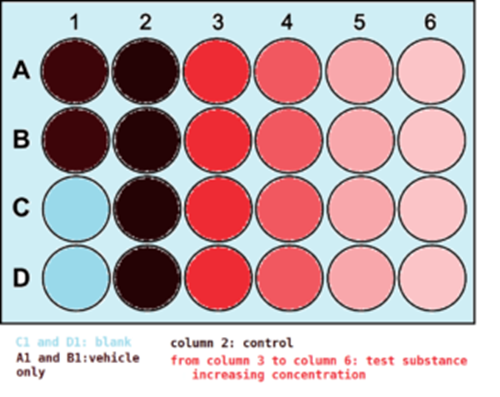
Here is a typical setup for experiments conducted in 96 or 24 multiwells. The 24 multiwell allow to evaluate the effects of a smaller number of concentrations, but more multiwells can be prepared. In this case it is always better to provide a blank column and one for the control even in the second multiwell.
For 96 multiwell, the first and last column as well as the first and last row are left empty (or better with PBS, to increase humidity and reduce evaporation in adjacent wells) to avoid the edge effect.
In the 24 multiwell the edge effect is not so strong and can be further reduced by placing sterile PBS in the spaces between the wells.
3.Add MTT solution in eanch well. MTT is light sensitive. Protect from light!
| Well type | 96 | 24 |
| μl of MTT solution | 10 | 50 |
(the final concentration of MTT will thus be 0.45 mg / ml)
4. Incubate for 1 to 4 hours at 37 ° C in the cell incubators. The formazan crystal can be seen under the microscope.
5. Add the solubilization solution.
| Well type | 96 | 24 |
| ul of solubilization solution | 100 | 500 |
6. Incubate on an orbital shaker in dark for 1 hour 150 cycles/min, to solubilize the formazan crystals.
7. Read the absorbance at 570 nm (plate reader or spectrophotometer).
8. Calculate absorbance of the sample by suctracting the absorbance of the blank.
A= A570-A570blank
In some cases the absorbance at 630nm is subtracted from the absorbance detected at 570nm. 630 nm is a wavelength where MTT has minimal absorption. Absorbance variations at this wavelength are exclusively attributable to the presence of cellular debries or spurs, change in path length, evaporation and fingerprints, that could interfere with the reading of the absorbance at 570 nm. The subraction allows to get rid of the variation of absorbance due to the presence of these debries.
A=A570-A630
Viability Calculation
Cell viability will be calculated relativelty to the viability of cells in control conditions
viability % = (Atreated_cells/Acontrol_cells)x100
where Atreated_cells is the optical density of the formazan released by treated cells
Acontrol_cells is the optical density of the formazan released by the control cells
Here is an excel file with examples and calculation: MTT_viability
In some cases the absorbance at 630nm is subtracted from the absorbance detected at 570nm. 630 nm is a wavelength where MTT has minimal absorption. Absorbance variations at this wavelength are exclusively attributable to the presence of cellular debries that could interfere with the reading of the absorbance at 570 nm.
Optimization of the MTT assay
For the method to be reliable, there must be a linear correlation between the number of cells and the absorbance of the developed color.
BEFORE proceeding with the experiments, it is necessary to verify that you are working with cells at a suitable density so that the correlation between density and color developed is linear.
The optimization of the method must be carried out BEFORE proceeding with the first experiments, by seeding cells of different densities and evaluating the linearity of the response. Furthermore, the concentration of MTT and the incubation time must not be too high to avoid cytotoxicity phenomena (which can be seen by observing the cells with an optical microscope).
In essence, therefore, it is necessary to plate the cells at different densities in the growth medium by making serial dilutions of a high-density cell suspension. Try first with the most used condition i.e MTT stock solution concentration of 0.5 mg/ml and 2 hours of incubation (these are the condition working best with most cells, in my experinece), and then adjust your condition properly.
this is just one example

Flow chart: optimize the assay, before proceeding with the experiment
Here is an excel file
optimization made to evaluate the assay optimization. The more the R2 of the trendline approaches 1, the better the correlation between cell density and absorbance.
The MTT concentration is generally used as indicated in the protocol at 0.5 mg/mL, but can be used in the range of 0.2 to 0.5 mg/mL, reducing it if the absorbance is too high.
However, an increase in the concentration is not recommended as it would excessively increase the cytotoxicity of the molecule, making the test unreliable.
If the signal is too low, however, what can be done is to increase the incubation time with MTT: longer incubation times will lead to greater color development. Even in this case, however, the time cannot generally exceed 4 hours maximum, due to the cytotoxic effect of the formazan if prolonged over time.
Concerns and care
It is important to note that MTT is an assay that depends on the metabolism of viable cells.
It is therefore necessary, before drawing any conclusion on the proliferation and number of cells, to set up appropriate controls to evaluate the effect on metabolism. Culture conditions that alter cell metabolism or affect the enzymes responsible for transformation of MTT may also affect the reduction of MTT to formazan, independent of cell proliferation and the number of cells in culture.
You need to pay attention to all of these factors to avoid catching fireflies for lanterns.
Glucose: If the glucose concentration in the culture medium is reduced, the metabolism slows down. For this reason it is advisable, if possible, to change the medium in which the cells are incubated a few hours before the assay or, at least, the day before.
pH of the culture medium and confluence: Other conditions that can artificially lead to a change in cell metabolism are the pH and the degree of confluence of the cells.
In some cases, formazan itself can have a toxic effect, altering cellular functionality.
Alterations in cell function due to MTT: The morphology of some cell types is strongly altered after the addition of MTT, suggesting a change in their physiology.
MTT toxicity depends on the MTT reagent concentration, incubate the more sensitive cells with a lower reagent concentration. In this case it is necessary to optimize the protocol.
Still other factors can interfere with the absorbance reading.
Phenol red: the phenol red contained in the medium can interfere with the absorbance reading. Since its color varies with the pH, as mentioned above, it is possible to use acid solubilization solvents or to use phenol red-free media.
Precipitation of proteins: some solubilization solutions can cause precipitation of proteins, interfering with the reading, it is therefore necessary to use another solvent
Incomplete solubilization of formazan crystals: increase the solubilization time or the intensity of agitation
Limits
- Due to the toxicity of formazan, the assay is an endpoint. You cannot reuse the cells for anything else, loosing these cells.
- Different cell types also differ in their metabolism. For this reason, the MTT test does not allow comparisons of cell numbers between cell types.
- Some chemicals can interfere with formazan, resulting in a detectable signal regardless of the presence of cells [5].
Reducing compounds can interfere with the MTT assay. Chemical compounds such as ascorbic acid or compounds containing sulfhydrils such as reduced glutathione, NAC, coenzyme A and DTT can induce a non-enzymatic and non-cellular reduction of MTT.
Remember to put these reagents also in the wells of the background to evaluate if it is not existent and risks masking veriations due to the cells.
- The high pH culture medium or exposure to direct light can cause a reduction in MTT, with an excessive increase in the background
Small bibliography
- 1. Mosmann, T. (1983). Rapid colorimetric assay for cell growth and survival: application to proliferation and cytotoxicity assays. Journal of immunological methods, 65 (1-2), 55–63.
- 2 . M. V. Berridge and A. S. Tan. (1993) Characterization of the cellular reduction of 3-(4,5-dimethylthiazol-2-yl)-2,5-diphenyltet-razolium bromide (mtt): subcellular localization, substrate dependence, and involvement of mitochondrial electron transport in mtt reduction. Arch 303(2):474–482
- 3. Michael V. Berridge, An S. Tan, Kathy D. McCoy, and Rui Wang. (1996) The biochemical and cellular basis of cell proliferation assays that use tetrazolium salts. Biochemica, 4:14–19
- 4. Tytus Bernas and Jurek Dobrucki. (2002) Mitochondrial and nonmitochondrial reduc tion of mtt: interaction of mtt with tmre, jc-1, and nao mitochondrial fluorescent probes. Cytometry, 47(4):236–242
- 5. Bella H Neufeld, Jesus B Tapia, Alec Lutzke, Melissa M Reynolds. Molecule Interferences in Resazurin and MTT-Based Metabolic Assays in the Absence of Cells. Anal Chem 2018 Jun 5;90(11):6867-6876. doi: 10.1021/acs.analchem.8b01043. Epub 2018 May 17.